Showing posts with label silver nitrate. Show all posts

Monday, June 14, 2021

Printing with Silver! (and SO MUCH MUCH MORE)

2 Thursdays ago (June 3rd) we got to actually make things together and managed to somehow magically be gifted a sunny day from the photo gods. 

We discussed word suffixes like phobic and philic in relationship to words they were already familiar with and how that related in a science context with chemistry. 

We talked more about silver nitrate and silver crystals, how there is a latent image in the darkroom which developer helps grow the crystals big enough so we can see them. We talked about how the visible light spectrum is different wave lengths and how we can see some of them as different colours - we talked about rainbows, prisms and how black and white photo paper makes colours with chemigrams and lumes- not with pigments or dyes but by reflecting back only those wavelengths of colour. 

we made our own photography developer using lemon juice and washing soda- then we talked about super addatives (multiplication of effect in phtoochemistry terms) by adding instant coffee.

we made our own fixer using what the origional photographers used- a basic salt that is commonly found for treating water to make it softer for fishtanks and pools. 

we talked about fabric dying and using resists referencing Batik and then applied that idea to photo paper and made chemigrams exploring 2 different resists(being liquid-phobic). 

we talked about Cliche Verrres and how they are the cross between printmaking, drawing and photography and then made our own which were printed using a solarising technique. 

We also found plants and made accelerated lumen prints / or chemi-lumens with the plants the sun and the photochemistry we made. 

We talked about the difference between photograms and contact prints

We also finally had you all make your chromas from your soil samples! (i'm really looking forward to seeing some of the photos your teachers took documenting- and yours too if you did take some please make a new blog post and add them). 


I've got some snaps of you making things on my instagram here 


Friday, April 23, 2021

Silver, Salt and Light:


How soil chromatography connects to the history of photography in Edinburgh and Scotland.


It's worth mentioning here that all the advancement in chemistry and innovation of photography might not be possible (or certainly delayed by who knows how long) if it weren't for a brilliant Scottish Chemist; Elizabeth Fulhame who discovered photoreduction with light, water and metal salts
(silver nitrate!) She published An essay on combustion : with a view to a new art of dying and painting. Wherein the phlogistic and antiphlogistic hypotheses are proven erroneous in 1794!

Only four years after the invention of photography was announced to the world in 1839, two Scots had mastered the new medium and were producing works of breathtaking skill in extraordinary quantities.

Photographs by Hill & Adamson explores the uniquely productive and influential partnership of David Octavius Hill and Robert Adamson, which lasted a few short years from 1843 until early 1848. These stunning images, which belie the almost unimaginable technical challenges faced by the duo, are arguably among the first examples of social documentary in the history of photography. 

Scott Monument on Princess St Edinburgh 
a salt print made from a calotype. 1843-47 year unkown
Monument was completed 1844


Whats so great about Hill, Adamson and Jessie Mann was that they really shaped the way we utilise photography- they were complete pioneers who used a very scientific and precise methodology to create amazing documentary and art photographs. Back in the day women weren't really credited often or even allowed to participate in many activities - so the team is usually referred to as Hill & Adamson- however Jessie Mann's work with them was a huge contribution to their success and is now hailed as Scotland's first woman photographer (that's why she gets her own link.)

Some gentlemen having a nice afternoon. 
James Ballantyne, Dr George Bell & David Octavius Hill
Taken by Adamson with likely help of Mann.

The photographs they made using the calotype process- which is really pretty tricky to get down, and not many people in the world still make them. Here's a link to the Calotype Society. Once they had an exposed and processed negative they would contact print the image onto salted and silver nitrate sensitised paper with sunlight and process it to get a positive print. 

It's neat because the chemistry we're using with the soil chromatography is really similar to the salted print process they used. They were using the most modern technology of the time and mastered it really quickly! Today's equivalent of the calotype negative would be similar to some crazy high res million megapixel camera, or even our smartphones.  The scenes they photographed look crazy old timey to us today- but that was contemporary life- well composed artful innovative photographs. 


Below is a calotype negative I made to try it out and the positive salted paper print below. I figured the Standard Life building on Lothian Road in Edinburgh looked pretty contemporary so I thought it might make a good modern Edinburgh shot using the same processes as Hill and Adamson. It was a few years ago- maybe I should photograph the new St James Centre in Edinburgh, or maybe the trams... What can you photograph that speaks to the contemporary life of today? 

Standard Life, Calotype and Salt Print by Brittonie Fletcher
you can see here my technical skills are not quite what Hill and Adamson's 
were with the Calotype process- if my negative were better the Salt Print
might look a tiny bit better!


Monday, April 19, 2021

Soil Chromatography!

So I mixed up all the materials and ingredients for soil chromatography- which you are all going to do this week!  


What is Chromatography?

Chromatography understands the soil as a being alive, in other words it is an unfinished process with elements working and living in symbiosis. Therefore the final result is a qualitative view of these processes and elements rather than a quantative one.

Chromatography gives you valuable information such as soil structure, general health of soil, minerals available for the plant, biological diversity, or organic matter content and humus available. It also assess the fertility of the soil through the integration of previous elements. 

This is a photographic process using capillary action to make beautiful abstract images which are also science information communication telling us about whats in the soil, and how healthy it is. The main ingredient after soil, water and paper is the Silver Nitrate we use as a sensitiser to make these images. 

gather all your materials.  first before you begin- there's nothing worse than finding you've forgotten something you need!


Health and Safety is important. I have a pair of reusable Nitril Gloves - nitril is the best glove for keeping stuff out and is non allergenic. Eye protection is really important. Also something to keep stuff off your clothes and body- I used to have a labcoat but now I have this awesome apron with a gold skull on it. 


the first photo is some of my soil sample after i ground it in a mortar and pestle and sifted it through a seive- much more uniform. Then i weighed out 5 samples of the same amount of soil and mixed it with the same volume of solvent. 


a theme emerging- i noticed my reflection in the pool of soil sample liquid in my petri dish. 
on the left i'm waving. 


Some Fun Silver Nitrate (AgNO3) Facts:

Silver Nitrate is used...

  • to test the exact salinity of Sea Water. (it’s about 35 grams per Liter, by the way…)
  • in Oil Fields to determine the amount of Chloride ions in water and drilling fluids.
  • in pharmaceuticals and treating skin and flesh wounds
  • to prevent premature shrinking/ dropping of buds & blooms, in cut flowers. (2.83% solution)
  • to inhibit cut flowers from making ethylene, which causes them to ripen
  • as a stain for proteins and nucleic acids in microscopy
  • as a glaze for ceramics (Raku and silver wash)
  • as a colourant in glass (blues and purples)
  • and 
  • As a sensitiser in Photography!
a still life of filter sensitization. 


this is a timelapse of capilary action- this process is
used 2x. the first to sensitise the filter paper with silver
the second to suck up the dirty water samples we made
interestingly, the obsorption time changes depending on 
what liquids we are soaking up- the silver was much faster
than the dirt! 
the music is a collaboration by RM Hubbert and Kathryn Williams 
off an albumn called "Tell the Trees"


these are two Chroma I finished soaking up dirty water with and taped them to my window to 'expose' and get the colours  and forms to deepen. 

Analysis of the Chromatogram or Chroma

The analysis of the final chromatogram - the filter paper - seems more difficult.

Comparison between before and after, different locations, may be easier than to pin-point exactly what is producing the patterns.


The different colours we obtain has to be a reflection of the chemical reaction with silver nitrate and whatever compound that is deposited there.


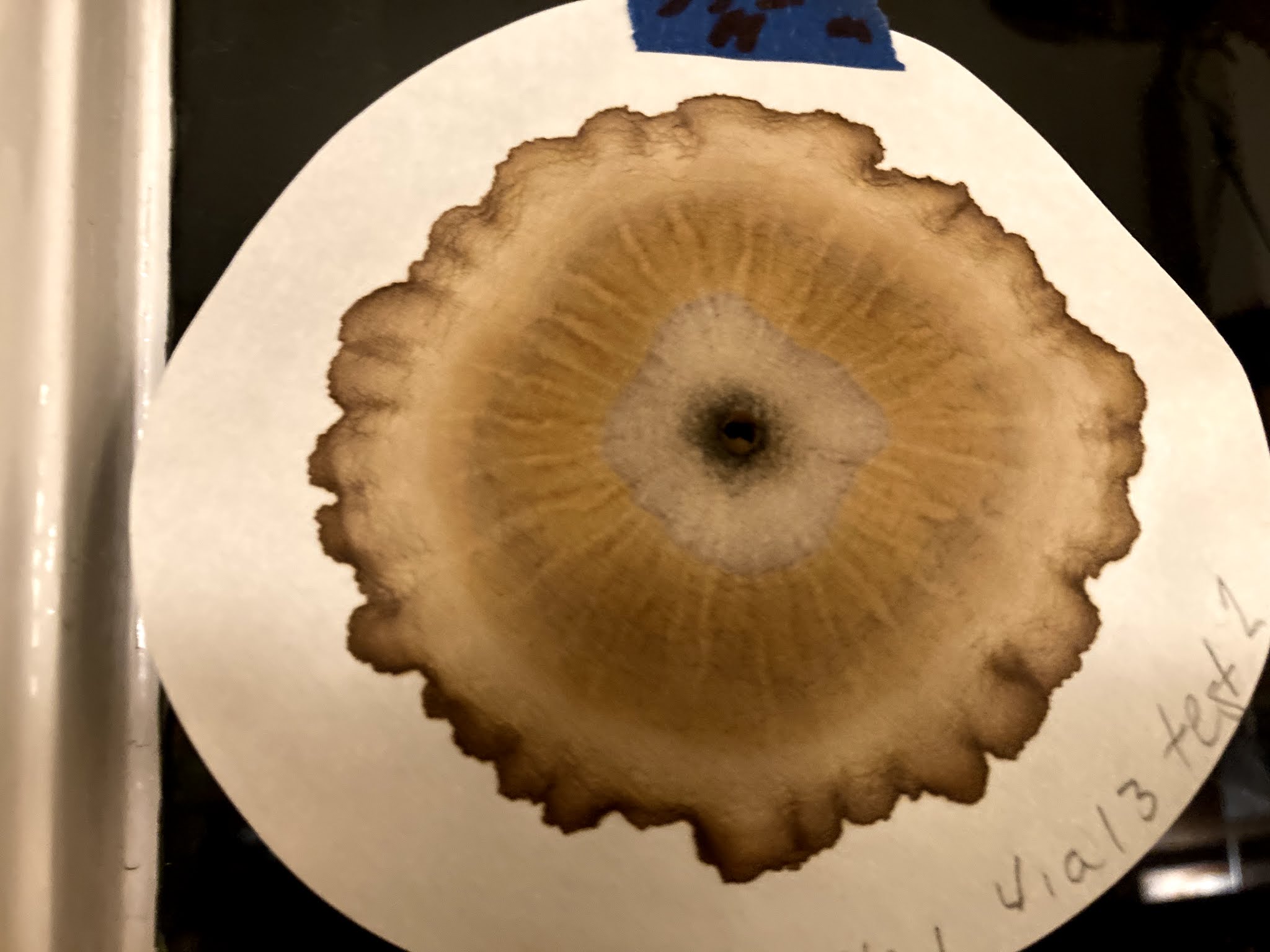
this was from sample 1 it reminds me of a tree stump
or a turkey tail fungi. What do the ones you've made remind you of? 


The general rule thumb:

  • the more complex the pattern the more organic the soil 
  • the less complex the pattern the less organic the soil
  • channels and spikes are a good indication of organic material
  • deep strong colours also indicate richer healthier soil

Pfeiffer's Criteria for Evaluation of Chromatograms
In his book Chromatography Applied to Quality Testing Pfeiffer gives the following pointers for interpreting the chromatography images:

1. Number, width and color of the different zones, as well as their regular or irregular formation and shading. Distinguish between 3 main zones:
       a)outer and middle mainly due to the organic material tested
       b) inner which indicates the presence or lack of mineralization
The width of the zones corresponds to the amounts of characteristic substances

2. Ring formations between the middle and outer zone and at the edge of the outer zone.

3. Color of the zones:
     a) a light to medium brown, evenly distributed, points to a good colloidal humus formation
     b) dark brown enclosures point to acid humus substances
     c) violet radiations point to increasing mineralization and reduced organic substance
     d) in the case of plant extracts, vitamin preparations and foodstuffs, other colors are observed.

4. Radiation, number, color and shape of pike-like formations
     a) the violet radiations of the inner zone again indicate the breaking-down tendency toward mineralization.
     b) the various phases of fermentation (first, decomposition; second, humus formation; third, mineralization and greatly advanced decomposition) are clearly indicated in the chromatograms of soils and compost.


two words you should try to get information on and include in your next blog post:

Solvents: what are they?
Extraction: what is this?
Take some photos of you preparing the chromatography, the chroma's taped to the window and some of them finished include the photos too! This is a pretty abstract portrait of the soil health where you found it. In a way it's photographic portrait of your environment!


these below are ones i didn't absorb the dirty water long enough and i tried to use different solvents to extract the materials from the soil. I like some of the different things that came from these material experiments- while they might not be as good for the science communication they sure are pretty! This is a great way that science and art overlap- there's a lot of *Experimentation* testing things out, trying different things looking for a result.