
Showing posts with label composition. Show all posts

Friday, April 23, 2021

Silver, Salt and Light:


How soil chromatography connects to the history of photography in Edinburgh and Scotland.


It's worth mentioning here that all the advancement in chemistry and innovation of photography might not be possible (or certainly delayed by who knows how long) if it weren't for a brilliant Scottish Chemist; Elizabeth Fulhame who discovered photoreduction with light, water and metal salts
(silver nitrate!) She published An essay on combustion : with a view to a new art of dying and painting. Wherein the phlogistic and antiphlogistic hypotheses are proven erroneous in 1794!

Only four years after the invention of photography was announced to the world in 1839, two Scots had mastered the new medium and were producing works of breathtaking skill in extraordinary quantities.

Photographs by Hill & Adamson explores the uniquely productive and influential partnership of David Octavius Hill and Robert Adamson, which lasted a few short years from 1843 until early 1848. These stunning images, which belie the almost unimaginable technical challenges faced by the duo, are arguably among the first examples of social documentary in the history of photography. 

Scott Monument on Princess St Edinburgh 
a salt print made from a calotype. 1843-47 year unkown
Monument was completed 1844


Whats so great about Hill, Adamson and Jessie Mann was that they really shaped the way we utilise photography- they were complete pioneers who used a very scientific and precise methodology to create amazing documentary and art photographs. Back in the day women weren't really credited often or even allowed to participate in many activities - so the team is usually referred to as Hill & Adamson- however Jessie Mann's work with them was a huge contribution to their success and is now hailed as Scotland's first woman photographer (that's why she gets her own link.)

Some gentlemen having a nice afternoon. 
James Ballantyne, Dr George Bell & David Octavius Hill
Taken by Adamson with likely help of Mann.

The photographs they made using the calotype process- which is really pretty tricky to get down, and not many people in the world still make them. Here's a link to the Calotype Society. Once they had an exposed and processed negative they would contact print the image onto salted and silver nitrate sensitised paper with sunlight and process it to get a positive print. 

It's neat because the chemistry we're using with the soil chromatography is really similar to the salted print process they used. They were using the most modern technology of the time and mastered it really quickly! Today's equivalent of the calotype negative would be similar to some crazy high res million megapixel camera, or even our smartphones.  The scenes they photographed look crazy old timey to us today- but that was contemporary life- well composed artful innovative photographs. 


Below is a calotype negative I made to try it out and the positive salted paper print below. I figured the Standard Life building on Lothian Road in Edinburgh looked pretty contemporary so I thought it might make a good modern Edinburgh shot using the same processes as Hill and Adamson. It was a few years ago- maybe I should photograph the new St James Centre in Edinburgh, or maybe the trams... What can you photograph that speaks to the contemporary life of today? 

Standard Life, Calotype and Salt Print by Brittonie Fletcher
you can see here my technical skills are not quite what Hill and Adamson's 
were with the Calotype process- if my negative were better the Salt Print
might look a tiny bit better!


Thursday, March 25, 2021

Photography and Video Composition


What Is the Rule of Thirds in Photography Composition?

The composition is how you arrange the subject and objects within your frame.

The rule of thirds is dividing your frame into nine equal rectangles. You can do this by creating two vertical and two horizontal lines. The four lines will intersect at four points. These are the points where your point of interests should be. You can do this mentally

A red grid showing the rule of thirds grid (two horizontal lines and two vertical lines)

How to Use Points of Interest

The relationship between negative space and the subject creates a natural focal point. By default, the viewer looks at the intersection points. Placing points of interest at one of these points balance your image. This also creates more tension, energy, and interest in the photograph.

In a portrait, the subject or other main points like the subject’s eyes, are important. Place these elements on one of the intersections.

For instance, the subject in the photo below is on one of the intersections. The same goes for landscape photography, like in the image below. Using the rule of thirds, the photographer placed key elements on the intersections.

Important Compositional Elements

Some images like landscapesseascapes, and cityscapes don’t have one point of interest. Aim to divide the image into one-third and two-thirds. For example, when capturing a landscape, use the rule of thirds to place the horizon on a horizontal line.

This photo below is more interesting. The landscape takes up 1/3 of the image, where the sky takes the remaining 2/3.

This is an effective way to show two elements, where one is more important than the other. This image would not be as dynamic if the sky were only 1/3.
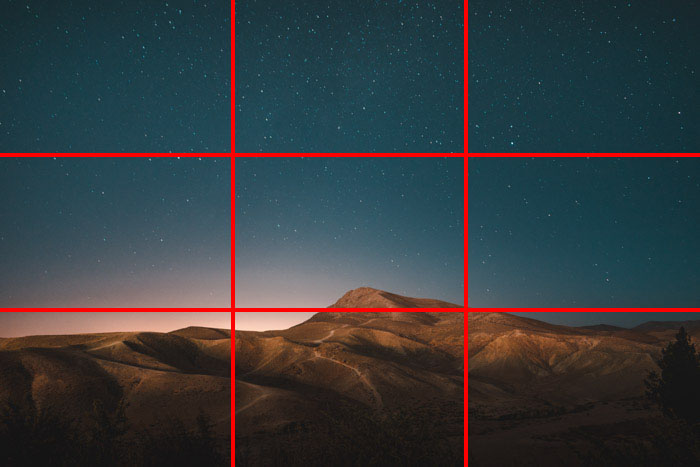
A mountainous scene with a stunning star filled night sky above, with the rule of thirds composition grid overlayed

Can You Break the Rule of Thirds?

Of course, you can break the rule of thirds. But before breaking the rule, it is important to learn it. In general, only break the rule for a specific reason.

Example: The subject doesn’t fall on any of the intersections. Nor are any of the key elements (things you want to make the viewer pay attention to) on the grid lines. The story behind the image was strong enough to justify breaking the rule.


Try these things while you're collecting your soil samples or doing activities in School next week with these challenges:

landscape- the area where you found the soil- try all around it and a landscape can also be a vertical or "portrait" oriented image. This can help with note taking- a visual record of the environment around you. Maybe there is some interesting archetecture, an unusual buisness that might effect the lanscape, maybe it's near water or perhaps there are flowers you like or litter you want to document to raise awareness. 

action - get some action shots of you collecting the samples, have a family member help or do some selfies. Documentary photography usually refers to a popular form of photography used to chronicle events or environments both significant and relevant to history and historical events as well as everyday life or science communication.

texture and abstract - get up close to the soil or interesting items you see around- experiment with angles and perspectives. Abstract photography, sometimes called non-objective, experimental or conceptual photography, is a means of depicting a visual image that does not have an immediate association with the object world and that has been created through the use of photographic equipment, processes or materials.

'Studio' Style

try taking some items home and putting them on a black background - I use my black hoodie as a background.  Try using directional lighting with a torch or window light, or the flash of your camera just to see how it changes the way the object looks.

I do the same thing with selfies or portraits -  using a black background and lighting I can make some professional looking images. 

I sometimes use Snapseed to edit my images later- it's a free phone image capture or editing app that's fun to play around with! If you have other things you want to do- like draw a picture or pictures from your outings or create some effects that would be great to see the inspiration and what you make with it. 

Composition is as important as lighting - but when in doubt I just take a lot of pictures from a lot of different angles and perspectives and have my friends help me pick the good ones later.

When you've made some photographs you like connected to the Soil activities (collecting and in school activity) post them to your blog along with any thoughts you had about it.